Phalaenopsis Orchid: Complete Guide to Get It to Rebloom
Why your orchid won't rebloom, how to trigger a new flower spike, prune, water and pick the right substrate. The full guide, no myths.
By SPRAIA editorial team · Method: botanical sources, field feedback and editorial validation
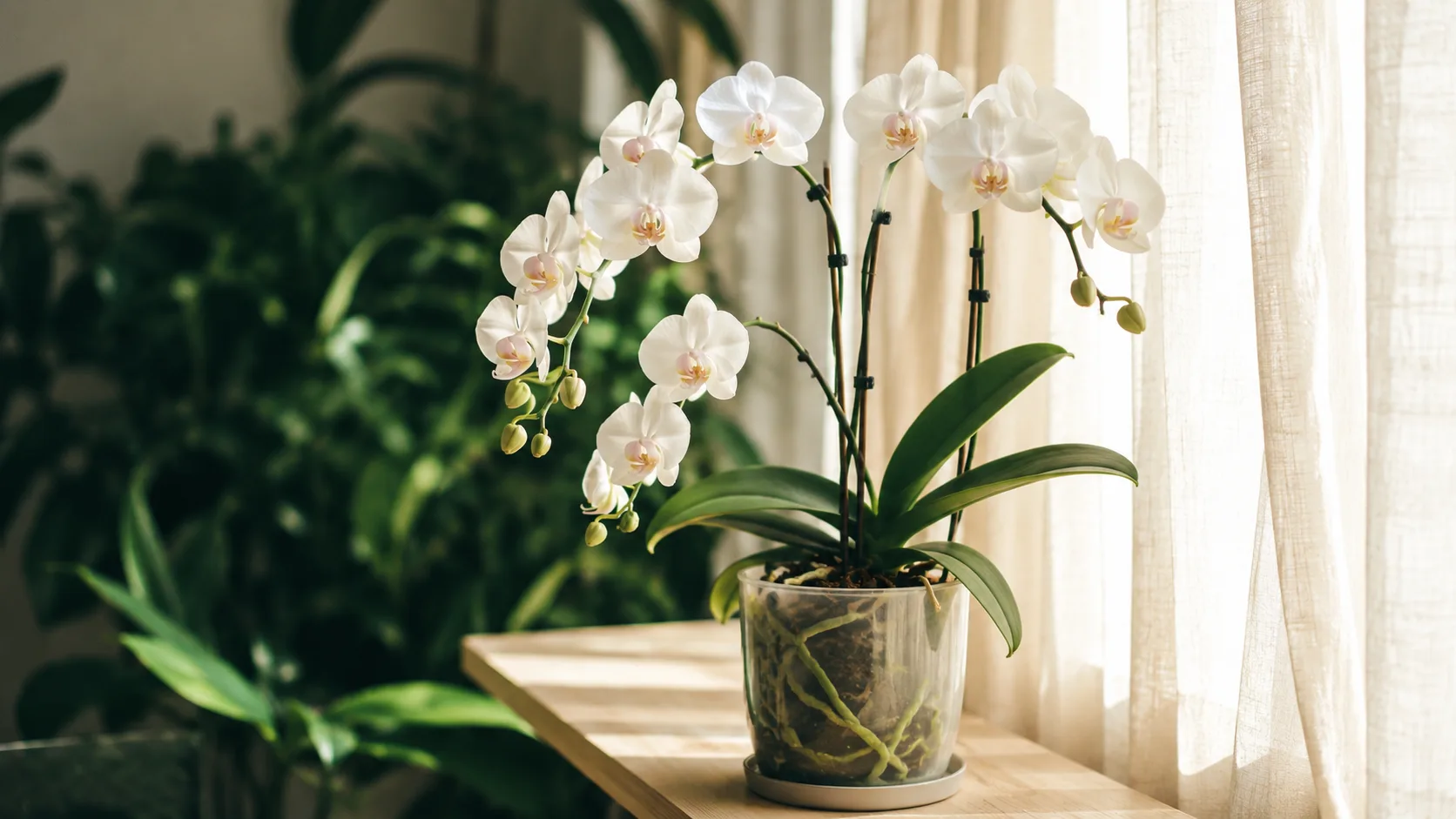
You bought your Phalaenopsis in full bloom — a cloud of open flowers for two or three months. Then the flowers dropped, the spike dried up, and since then… nothing. Green leaves, the occasional aerial root, but no new blooms. Six months pass, then a year, and you start wondering if your orchid is permanently “broken”. Good news: it isn’t. It’s almost certainly in perfect health. It’s simply waiting for the right signal to rebloom — and that signal is one you can give it.
Understanding the Phalaenopsis cycle
In its natural habitat — the canopy of South-East Asian forests — the Phalaenopsis is an epiphyte. It grows clinging to tree branches, roots exposed to the air, bathed in filtered light and high ambient humidity. It doesn’t flower continuously: it blooms once a year, usually after the cool season of the tropical winter.
A Phalaenopsis annual cycle looks like this:
- Blooming (2 to 4 months): the spike develops, buds open one after the other.
- Vegetative rest (6 to 9 months): the plant produces new leaves and roots. This is the phase where you think “nothing is happening”.
- Flower initiation: triggered by a night-time temperature drop (see below), the plant sends out a new spike.
- Bud stage (6 to 10 weeks): the spike grows, buds swell and eventually open.
The problem with most apartment Phalaenopsis is that they stay stuck in the resting phase because their environment is too stable. A constant 21 °C day and night, all year long, never triggers the flowering signal.
Trigger number one: the night-time temperature drop
This is the key 90% of orchid owners overlook. For an orchid to send out a new spike, it needs a day-to-night temperature difference of at least 5 to 8 °C, for 3 to 4 consecutive weeks.
In practice:
- Day: 22-24 °C (normal indoor temperature)
- Night: 14-17 °C
How do you get there? The season helps. Autumn is the ideal moment: crack a window at night (without a direct draught), or move the plant to an unheated room. A conservatory, a cool office, an unheated bedroom work perfectly. If you try this in spring, results are more hit-or-miss.
This controlled stress mimics the cool tropical season and signals the plant: “it’s time to reproduce”. A few weeks later you’ll see a small green tip appear between two leaves at the base — that’s the new flower spike.
Light: bright, but never direct
The Phalaenopsis lives under the canopy: it receives plenty of light, but always filtered by the leaves above. Direct sun burns its thick leaves in a few hours.
The ideal spot at home:
- East-facing window (soft morning sun): perfect
- West-facing window: good, with a sheer curtain in summer
- South-facing window: only behind a sheer, never in full sun
- North-facing window: possible, but blooming will be rarer
In numbers, aim for 10,000 to 20,000 lux for most of the day. If your leaves turn a very dark green, the plant lacks light (photosynthesis slows and the plant won’t have the energy to bloom). If they turn pale yellow-green, it’s the opposite — too much direct sun. The ideal colour is a bright, slightly glossy fresh green. To calibrate this precisely, check our complete light guide.
Watering: soak, never schedule
The most common mistake: watering on a schedule (“every Sunday”). An orchid isn’t thirsty every seven days. It’s thirsty when its substrate is almost dry and its roots have shifted from bright green to silver grey.
The soak method
This is the most reliable technique:
- Place the clear pot (without its decorative cover pot) in a bowl of room-temperature water.
- Let it soak for 15 to 20 minutes. The bark slowly absorbs the water.
- Take the pot out and let it drain for 10 minutes.
- Return it to the cover pot (empty of standing water).
Repeat every 7 to 14 days depending on season, light and pot size. In winter, it can be every 15-20 days.
How to know if it’s thirsty
- Green roots in the clear pot = still moist, wait.
- Silver grey roots = dry, time to water.
- Light pot when you lift it = dry.
- Slightly wrinkled, limp leaves = chronic thirst, you’ve waited too long.
Most of all, ban the ice cubes. The “3 ice cubes a week” myth pushed by certain brands is a disaster: the cold shocks tropical roots and the water amount is far too low. If you see leaves yellowing mysteriously, also see our yellow-leaves diagnosis guide.
Substrate: bark, not potting soil
A Phalaenopsis never grows in soil. Its roots need air — a lot of air. The correct substrate is made of medium-grade pine bark, sometimes mixed with a bit of sphagnum moss, clay pellets or charcoal.
Why? Because Phalaenopsis roots actually photosynthesise (yes, really — that’s why they turn green when wet) and they need to breathe between waterings. A substrate that’s too dense or holds too much water dooms the plant to rot in a few months.
When to repot
Every 2 to 3 years, or as soon as the bark breaks down into dark brown powder. Do it right after blooming, never during. Pick a clear pot only slightly bigger — orchids like to be a bit cramped. If you find black, mushy roots at repotting time, see our guide to saving a plant from root rot.
Pruning the spike after bloom: the real answer
This is probably the most-asked question, and the answer floating around at garden centres is often wrong.
Never cut the spike at the base as long as it’s still green. A green spike can produce new flowers on the following nodes.
The correct method:
- Spike still green after flowers drop: cut 2 cm above the second or third node from the bottom. With a bit of luck, a side branch will bloom in 2-3 months.
- Entirely yellow or dried spike: there, yes, cut 1 cm from the base. It won’t bloom again, so let the plant focus its energy elsewhere.
- Half-dried spike: cut just above the last still-green node.
Always use scissors disinfected with alcohol to avoid introducing a pathogen into the wound.
Aerial roots: leave them alone
You see those silver roots coming out of the pot and climbing in all directions? That’s perfectly normal. In the wild, those aerial roots are how the plant absorbs moisture from the air and clings to its support.
Don’t cut them, don’t bury them, don’t force them back into the pot. If you want to hydrate them, mist them lightly with non-calcareous water from time to time. An orchid with plenty of green, firm aerial roots is an orchid in excellent shape.
The only roots to remove are those that are mushy, brown and hollow to the touch: those are dead. Cut them at repotting.
Fertiliser: little, but regular
During the growth phase (spring-summer), apply an orchid-specific fertiliser diluted to half the recommended dose, roughly every other watering. In winter, stop or halve again. Too much fertiliser burns the roots and causes a brown tip on the leaves.
A classic tip: alternate one watering with plain water and one with fertilised water. This prevents mineral salts from building up in the substrate.
Habits to drop today
To recap, here are the six most damaging habits:
- Cutting the spike at the base after blooming — you kill the chance of an immediate re-bloom.
- Watering on a schedule — your roots rot from excess water.
- Using ice cubes — a pointless thermal shock on a tropical plant.
- Repotting in regular potting soil — guaranteed suffocation.
- Hiding the plant in a dark corner after blooming — no light, no rebloom.
- Stressing the plant by moving it too often — Phalaenopsis hate sudden changes in orientation.
How long before a new bloom?
Let’s be realistic: between the moment you apply this advice and the first visible spike, count 3 to 9 months. A plant that hasn’t bloomed in two years may need a full season of recovery before resuming its cycle. Patience.
The sign it’s working: one evening, you see a small bright green tip poking out between two leaves at the base, distinct from a root (which would point downwards and look greyer). That tip will grow 1 to 2 cm per week, then branch, and finally form buds. Don’t move the plant anymore — the slightest rotation can make the spike grow crooked.
Frequently asked questions
- In 9 cases out of 10, the night-time temperature drop is missing. A Phalaenopsis kept at 21 °C day and night all year long never receives the flowering signal. Try 3-4 weeks of 22 °C / 15 °C day-night contrast in autumn, then wait a few months.
- Not while it's still green. Cut 2 cm above the second or third node from the base: the plant can form a flowering branch in a few months. Cut at the base only if the entire spike is yellow or dried out.
- Totally normal. The Phalaenopsis is epiphytic: its aerial roots absorb moisture from the air and are essential to its health. As long as they are green or silver and firm, don't cut them and don't bury them.
- No, that's a dangerous marketing myth. Phalaenopsis are tropical: direct contact with cold damages the roots, and the water from 3 ice cubes is far too little. Prefer a 15-20 minute soak every 7-14 days.
- Bright light without direct sun: east-facing window, or west and south with a sheer curtain. Aim for 10,000-20,000 lux. Bright glossy green leaves indicate good light; very dark green = too low; yellow-green = too much direct sun.