Anthurium: Complete Care Guide and Reflowering Secrets
Light, watering, humidity, substrate, fertiliser: every secret to make your Anthurium rebloom and keep those glossy spathes going for weeks.
By SPRAIA editorial team · Method: botanical sources, field feedback and editorial validation
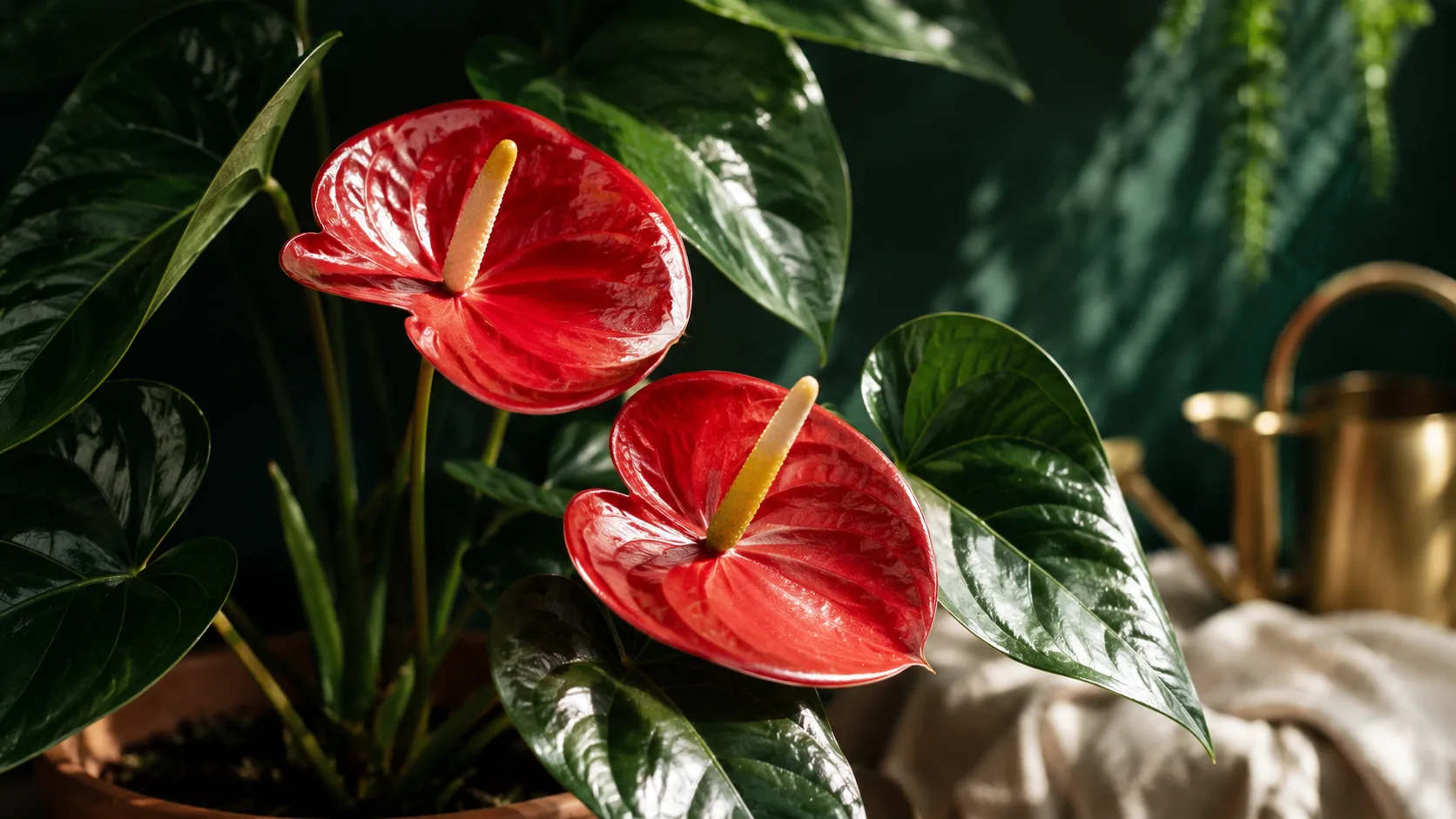
The Anthurium is arguably the most iconic flowering houseplant: those red, white, or pink spathes last six weeks, sometimes more, and light up a room like no other plant. Yet many plant parents buy one in full bloom, enjoy the flowers… and then end up with a green plant that stubbornly refuses to bloom again. This block isn’t mysterious at all: it almost always comes from a misunderstood detail in the care routine. Once you adopt the right habits, an Anthurium can produce new spathes year-round in successive cycles. Here’s the complete guide to understanding this tropical plant and getting it to rebloom reliably.
The Anthurium in a nutshell
The Anthurium belongs to the broad Araceae family, alongside Monsteras, Philodendrons, and Alocasias. Native to the humid tropical forests of Central and South America, it grows naturally as an epiphyte or semi-epiphyte — clinging to trees or rooted in very well-drained soils rich in decomposing organic matter. This dual origin directly shapes its needs indoors.
Our houseplant family guide places the Anthurium in its botanical context: understanding the Araceae family means understanding most of the plants in your living room.
Spathe or flower? Let’s clear it up
What most of us call the “flower” of an Anthurium isn’t a flower in the botanical sense. The flat glossy coloured part is a spathe, a modified leaf that exists to attract pollinators. The true flowers are the tiny tightly packed dots running along the spadix, the small spike sticking up at the centre. Together, spathe and spadix form the inflorescence typical of Araceae.
This distinction isn’t just cosmetic: the incredible longevity of an Anthurium “flower” (six weeks on average) is precisely because the spathe is a modified leaf, not a fragile petal.
Species and cultivars to know
- Anthurium andraeanum: the florist classic, heart-shaped spathes in red, white, pink, orange, or even near-black depending on the cultivar. This is what you’ll find everywhere.
- Anthurium scherzerianum: smaller spathe, spiralled orange spadix, more compact plant.
- Anthurium clarinervium: grown for its spectacular foliage, deep green with raised white venation. Rarer and more humidity-demanding.
- Anthurium crystallinum: another foliage gem, silver veins on dark green velvety leaves.
Enthusiasts split the genus into two camps: “flowering” Anthuriums and “foliage” Anthuriums. This article focuses on the former, but the core care principles are very similar.
Light: the first secret of reflowering
The Anthurium loves bright indirect light. An east or west window with light filtering, or a south window 1-2 metres back behind a sheer curtain, is ideal. In a dim room, reflowering is impossible — the plant needs that light energy to initiate new inflorescences.
Conversely, harsh summer sun can brown the spathe and scorch the leaves. If you see leaves yellowing between veins or pale brown spots appearing, it’s likely too much direct sun.
Our complete light guide helps you precisely measure what your Anthurium has. If needed, move it gradually over 1-2 weeks to avoid shock.
Watering: regular without overdoing it
The Anthurium likes a moist but never soggy substrate. The rule: water when the top two centimetres feel dry to the touch. Depending on the season, that means:
- Spring-summer: every 4 to 6 days.
- Autumn-winter: every 7 to 10 days.
Use room-temperature water, ideally low in calcium. Cold water is the Anthurium’s enemy number one: a winter watering with icy tap water can shock the plant and trigger widespread yellowing.
Our houseplant watering guide covers seasonal best practices in detail.
Yellow leaves: an alarm signal
If your Anthurium is yellowing, nine times out of ten it’s overwatering. Check that:
- The pot has proper drainage holes.
- Water doesn’t sit in the saucer (empty it 15 minutes after watering).
- The substrate isn’t too dense (plain potting mix is a bad choice).
Our yellow leaves troubleshooting guide lists every possible cause and its fix.
Humidity: the underestimated factor
Native to tropical forest, the Anthurium thrives in ambient humidity of at least 60%. In a heated home in winter, you often drop to 30-35%, which is why tips brown and the plant refuses to rebloom.
Effective solutions:
- A room humidifier (most reliable).
- A tray of damp clay pebbles under the pot.
- Grouping plants together (they create their own microclimate).
Direct misting on the foliage is tolerated but barely effective: the humidity lasts a few minutes at most.
The perfect Anthurium substrate
Like other epiphytic aroids, standard houseplant mix is too dense. Go for an airy blend that mimics the conditions of a tropical tree.
Recommended mix:
- 40% medium or fine pine bark (orchid grade)
- 25% perlite or pumice
- 20% potting mix or peat
- 15% sphagnum moss or coco fibre
This substrate retains just enough moisture for the roots without ever drowning them. Switching to 100% mineral substrate like pon is also a great option for gardeners who tend to overwater.
Fertiliser: the step everyone forgets
An Anthurium that never reblooms is very often an Anthurium that’s never been fed. To produce new spathes, the plant needs regular nutrition during its growing season.
Choose a fertiliser rich in phosphorus (the P in NPK), often labelled “bloom booster” or “orchid feed”. Apply every 2-3 weeks from March to October at half the recommended strength, on already slightly damp substrate to avoid burning roots.
Our natural fertilisers guide also covers gentler alternatives (worm castings, cooled vegetable cooking water) that work perfectly for Anthuriums.
Aerial roots: keep or cut?
The Anthurium naturally produces aerial roots that emerge from the pot — a sign of a healthy plant trying to catch ambient moisture. Don’t cut them: they play a real physiological role.
You can mist them lightly or coil them toward the substrate when repotting. If they become genuinely invasive, it’s probably a signal that it’s time to repot into a slightly larger container.
Conditions for reliable reflowering
To trigger new inflorescences, combine these levers:
- Bright indirect light at least 8 hours a day.
- Humidity ≥ 60%, especially in winter.
- Phosphorus fertiliser every 2-3 weeks during growing season.
- Cool winter rest: 6 weeks at 16-18 °C with strongly reduced watering, to stimulate future bud formation.
- Spent spathes cleanly cut at the base of their stalk, to redirect energy to new shoots.
With these five levers, a mature Anthurium produces 4 to 6 new inflorescences per year, sometimes more.
Toxicity: caution with pets and children
Anthuriums contain calcium oxalate crystals in every part. Chewing or biting causes pain, drooling, and oral swelling in cats and dogs. Keep it out of reach of pets and small children.
Our toxic plants for children and pets guide lists the main species of concern and offers safer alternatives.
Common mistakes to avoid
- Cold tap water: thermal shock and yellowing.
- Direct sun: irreversible brown patches on the spathe.
- Dense generic potting mix: root rot.
- No fertiliser: foliage stays put but no new flowers.
- Dead spathe left in place: wasted energy, slower growth.
Conclusion: a classic that earns its reputation
The Anthurium isn’t a difficult plant: it simply needs you to respect its tropical and epiphytic nature. Bright indirect light without harsh sun, very draining substrate, high humidity, lukewarm water, phosphorus feed in season, and a cool winter rest: those six habits turn your Anthurium into a near-permanent flowering plant. And when you see a new red or white spathe push between the leaves, you’ll understand why this plant has stayed in fashion for more than a century.
Frequently asked questions
- Check three things: light (bright indirect minimum), feeding (phosphorus-rich fertiliser every 2-3 weeks from March to October) and winter rest (6 weeks at 16-18 °C with reduced watering). It's almost always the combination of these three factors that unlocks reflowering.
- Spathes can shift from red to green at the end of a cycle — that's normal and gradual. But if every new spathe comes out green, that's a sign of insufficient light. Move the plant closer to a bright window to restore vivid colour.
- Yes — as soon as the spathe is fully faded, cut the stalk as close to the base as possible with clean scissors. This redirects energy to new shoots and stimulates inflorescence production.
- The ideal range is 60-80%. Below 50%, you risk brown tips, aborted flower buds, and stalled reflowering. A room humidifier remains the most reliable solution, especially in winter with heating running.
- Every 2 to 3 years in spring, into a pot barely larger (3 cm of additional diameter). Take the chance to refresh the airy substrate and inspect the roots: remove any that are brown or mushy — a sign of rot.