Root Rot: Saving an Overwatered Houseplant
Diagnose root rot and save an overwatered plant: signs, root pruning, emergency repotting and lasting prevention.
By SPRAIA editorial team · Method: botanical sources, field feedback and editorial validation
It’s probably the worst enemy of the beginner plant parent: root rot. Silent, sneaky, it sets in over a few weeks out of sight, in the pot. By the time the first surface symptoms show — limp leaves, yellowing, plant collapsing — it’s often almost too late. Almost, only. With a fast diagnosis and the right moves, you can save a plant on the brink. Here’s how.
What is root rot?
Root rot is a fungal disease caused by opportunistic fungi that thrive in overly wet, poorly aerated substrate. The usual culprits have ominous names: Pythium, Phytophthora, Fusarium, Rhizoctonia. All need the same thing to grow: too much water, not enough oxygen.
In waterlogged substrate, healthy roots can’t breathe. Starved of oxygen, they die. Fungi colonize that dead tissue and march on toward still-healthy roots. The plant loses its ability to absorb water and nutrients — cruel paradox: it can dehydrate while sitting in water.
Why it’s so common indoors
Three structural causes:
- Chronic overwatering: cause #1. We water by habit, by calendar or by guilt, without checking the substrate.
- Pots without drainage: water pools at the bottom, lower roots rot quietly.
- Overly dense substrate: a heavy, compact mix retains too much water and suffocates roots.
Often all three combine: decorative pot without a hole + weekly watering on autopilot + cheap potting mix. Perfect rot cocktail.
Recognising the signs
The challenge: rot starts invisible (at the bottom of the pot) before climbing to the surface. A few signs help catch it early.
Surface signs
- Limp, yellow leaves despite moist soil — the plant can’t take up water
- Brown leaf edges or diffuse black spots
- Plant wilting while you water regularly
- Growth abruptly stops
- Stem softens at the base, turns brown or black
- Mouldy or rotten-egg smell when you sniff near the pot
- Fungus gnats around the pot (sciarids love sodden, putrefying substrate)
The ultimate test: unpot the plant
If in any doubt, slip the plant out. Non-negotiable. Once the rootball is exposed, observe:
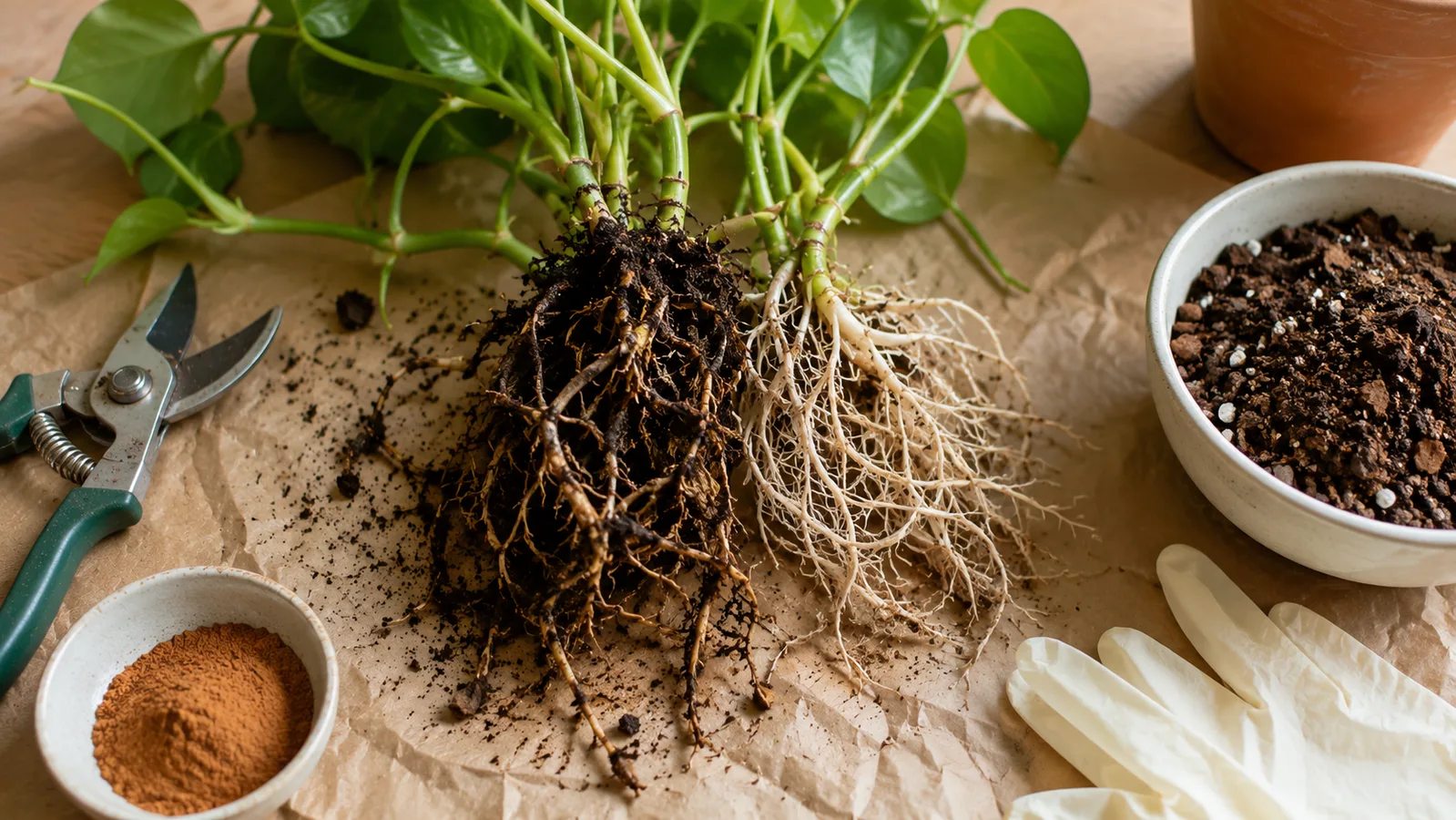
- Healthy roots: white, firm, springy under the fingers
- Rotten roots: black or brown, mushy, crushing or detaching at the slightest touch
- Smell: healthy substrate smells like forest floor. Rotten substrate smells like egg, swamp, death
If more than 70 % of roots are black and mushy, prognosis is very poor. Between 30 and 70 %, rescue is possible. Below 30 %, the plant almost always recovers.
To distinguish root rot from other causes of yellow leaves, see our yellow leaves diagnostic guide — it details every possible cause with its solution.
Emergency rescue: full procedure
Timing is critical. The earlier you act, the higher the rescue odds. Set up your station: newspaper, very clean shears (70 % alcohol), water, cinnamon powder, optional natural fungicide, new pot, fresh and dry substrate.
Step 1 — Unpot and clean
Slip the plant out. Remove all old substrate working dry or under a thin trickle of warm water to expose roots. Don’t be shy: every bit of substrate is contaminated and has to go.
Step 2 — Cut without mercy
With disinfected shears, cut every rotten root: black, brown, mushy, smelly. Cut into healthy tissue (the root must be white at the cut).
Disinfect shears between major cuts (70 % alcohol) to avoid spreading fungi. If unsure where to cut, be generous: better cut too much than too little. A doubtful root hidden among healthy ones can recontaminate everything.
Step 3 — Disinfect
Three options from gentle to radical:
- Cinnamon powder: natural antifungal. Dust on cuts and the entire root system.
- Activated charcoal: alternative or complement to cinnamon, same antiseptic role.
- Fungicide solution: 15-minute soak in a diluted systemic fungicide (copper- or propamocarb-based) for serious cases. Follow doses strictly.
For most mild-to-moderate cases, cinnamon is plenty.
Step 4 — Air-dry (optional but recommended)
For severe cases, let the roots air-dry 12 to 24 hours before repotting. This drying kills residual fungi that need moisture to survive.
Step 5 — Repot in fresh substrate
Pick a smaller pot than the previous one if you cut a lot: fewer roots = less volume needed. An oversized pot would be counterproductive (too much water around reduced roots).
Repot in completely dry substrate, more draining than usual:
- 50 % fresh houseplant potting mix
- 30 % perlite
- 20 % pine bark
Don’t pack too hard. Crown stays at the surface. For procedure details, see our complete repotting guide.
Step 6 — Above all, do not water
Counterintuitive but essential: don’t water for 5 to 10 days after emergency repotting. Wounded roots need to heal dry. Watering immediately restarts the rot cycle.
After 5-7 days, check: if the substrate is bone dry 5 cm deep and the plant looks stable, give a light watering (a quarter of the usual dose).
Aftercare
The next 4-8 weeks are crucial. Your plant is convalescing.
Optimal conditions
- Bright but indirect light — no direct sun (dehydration risk)
- Stable temperature between 20 and 24 °C
- Moderate ambient humidity (50-60 %) — without excess, to avoid restarting fungi
- No fertilizer for 6 to 8 weeks: wounded roots would burn instantly
- No handling: no moves, no repotting, no pruning
What to expect
- Week 1-2: the plant may shed a few more leaves. Normal — it scales down to match a reduced root system.
- Week 3-4: stabilization. Remaining leaves firm up, no new yellowing.
- Week 5-8: recovery. A new shoot appears: roots are reforming.
If after 8 weeks no new growth appears and leaves keep falling, prognosis turns grim. Don’t despair too fast though: some plants (Monstera, ZZ, Sansevieria) take longer than others.
Special cases
Stem rotted at the base
If rot climbs into the stem (black, mushy, smelly stem at the base), saving roots isn’t enough. You need to propagate the healthy section:
- Find the line between healthy and diseased tissue
- Cut well into healthy tissue, 5-10 cm above the suspect zone
- Disinfect the cut (cinnamon)
- Air-dry 24 hours
- Put the cutting in water or fresh substrate depending on species
Sometimes you lose the mother but save the lineage.
Hydroponic / PON plant
If you’ve moved your collection to PON mineral substrate, rot is much rarer — but can happen if the water reservoir stagnates. Rescue: total drain, pebble rinse, prune rotten roots, restart with fresh water.
Succulents and cacti
Succulents rot from the base very quietly. If the plant has gone soft, translucent or the base mushes up, prognosis is bad. Try head propagation: cut the healthy top, let it callus 1 week dry, plant in dry substrate.
Orchids
For a Phalaenopsis, watch the colour of the aerial roots: green after watering, white/silver between. If they turn brown and mushy, rot has set in. Repot in completely dry orchid mix and drastically space waterings.
Prevention: 8 golden rules
Better to prevent than to attempt to cure. Habits to build:
- Check moisture before watering — finger pushed in 3-5 cm. If moist, wait. Our complete watering guide details every checking method.
- Mandatory drainage — at least one hole. Decorative cover pot optional.
- Draining substrate — perlite, bark, coco coir according to species.
- Empty saucers 15 minutes after watering — never standing water.
- Adjust per season — halve watering frequency in winter.
- Pots matched to plant size — neither too big nor too deep.
- Monthly inspection — gently lift the plant: if the rootball comes out as a block, check the roots.
- Space your plants — good airflow, no concentrated humidity.
Fatal mistakes to avoid
- Watering because leaves are limp — limp leaves can signal too much water as much as too little. Check substrate first.
- Watering on a fixed schedule without looking at soil state — actual need varies with season, light, temperature, growth.
- Putting clay pebbles at the bottom for drainage — this is a myth. Without a drainage hole, pebbles do nothing (and with drainage, they’re not essential).
- Repotting without disinfecting the pot — a pot that hosted a rotten plant can pass spores to the next tenant.
- Hesitating to cut roots — every day with rotten roots spreads infection.
Frequently asked questions about root rot
The questions that come up most when you find a plant on the brink of drowning.
- As long as at least 20–30% of the roots stay white and firm after pruning, the plant still has a real chance. If every root is black, mushy and falls apart at the slightest touch, and the base of the stem is also blackened and spongy, the infection has spread upward and the prognosis is grim. In that case, try taking a healthy cutting from the upper part of the stem.
- Count 4 to 8 weeks before you see signs of recovery (new roots, a new leaf). During that time, the plant devotes all its energy to rebuilding its root system, so there's no visible aerial growth. Avoid any fertilizer for at least 6 weeks and water very sparingly.
- Yes, moderately. Ground cinnamon sprinkled on the cut sections has a mild natural antifungal action. Activated charcoal added to the repotting mix absorbs some spores and limits water retention. Neither replaces root pruning, but both reduce the risk of reinfection.
- No, definitely not. Wait 5 to 7 days before the first light watering. The plant has just been through a trauma and its cut roots need to scar over dry to avoid reinfection. The substrate should stay barely damp, never soaked, for the first few weeks.
- Yes, if the initial cause isn't corrected. Rot is a symptom, not a stand-alone disease: it reflects chronic overwatering, a poorly drained pot or compacted substrate. Check your [watering routine](/en/blog/when-how-water-houseplants/), switch to a free-draining mix, and move to a pot with drainage holes if that wasn't already the case.
Conclusion
Root rot kills more houseplants than every pest combined. But it isn’t fate: with early diagnosis — limp leaves despite watering, smelly substrate, growth stalled — and a rigorous emergency procedure (unpot, prune, disinfect, dry repot, no immediate watering), many seemingly lost plants restart within weeks.
The best strategy remains prevention: watering matched to each plant, draining pots, aerated substrate. With SPRAIA, identify your plants precisely, get watering reminders personalized by species, season and environment, and photograph early signs for instant diagnosis. Your plants deserve that level of vigilance — and you, the peace of mind of never losing one to overwatering again.