Indoor Succulents: The Guide to Never Killing Them Again
Why 90% of indoor succulents die, top 10 easy species, light, watering, substrate and decline signs you must recognise.
By SPRAIA editorial team · Method: botanical sources, field feedback and editorial validation
You’ve probably already killed a succulent. Don’t take it personally — you’re in the vast majority. According to UK garden centres, more than 80% of succulents sold for indoor use don’t make it past their first year. You made what looked like an obvious pick — “those cute little plants you barely have to water” — and three months later, you’re staring at a soft, stretched rosette, or worse, a puddle of black mush. Bad news: succulents are not easy plants. Good news: their needs are simple — extremely simple — once you understand them. Here’s the guide that will keep you from doing it again.
Why 90% of succulents die indoors
First things first: let’s understand why your succulents keep dying. There are two causes, and always the same two causes: too much water, and not enough light. Often both at once.
Cause 1: overwatering
A succulent stores water in its fleshy tissues. In its native habitat (deserts, semi-deserts, rocky environments), it gets rain in episodic, intense bursts, followed by weeks of complete drought. Its roots are built for that brutal cycle.
Indoors, you water it “a little, often” because you see the topsoil drying out. Wrong. The substrate of a succulent should dry all the way through, and the plant should even stay a few days in water stress before the next watering. Otherwise, the roots rot silently and by the time you see the base going soft, it’s already too late. If that’s what’s happening, check our guide to saving a plant from root rot fast.
Cause 2: not enough light
That’s the other silent killer. Succulents need intense light, ideally several hours of direct sun a day. “Nice light” in a flat, 1-2 metres from a north- or east-facing window, is never enough long-term. The plant survives a few months, then stretches — the leaves space out on the stem, colours fade, the rosette warps.
A stretched succulent is already doomed if you don’t fix the light immediately. The cruel twist: stretching usually precedes the fatal watering, because a weakened plant rots much faster.
Cactus, succulent: what’s the difference?
A quick vocabulary point that helps. All cacti are succulents, but not all succulents are cacti.
- Cacti: family Cactaceae. Defining feature = areoles (small cushions from which spines, flowers and new growth emerge).
- Succulents: blanket term for any plant that stores water in its leaves, stems or roots. Includes cacti, but also echeveria, sedum, crassula, aloe, haworthia, etc.
In practice, their needs are nearly identical: bright light, infrequent watering, well-draining substrate. The main difference is winter cold tolerance (globular cacti often handle the cold better).
Top 10 easy succulents for indoor life
Not all succulents are equal indoors. Some demand the height of summer sun, others tolerate partial shade. Here are the 10 species best suited to a typical home.
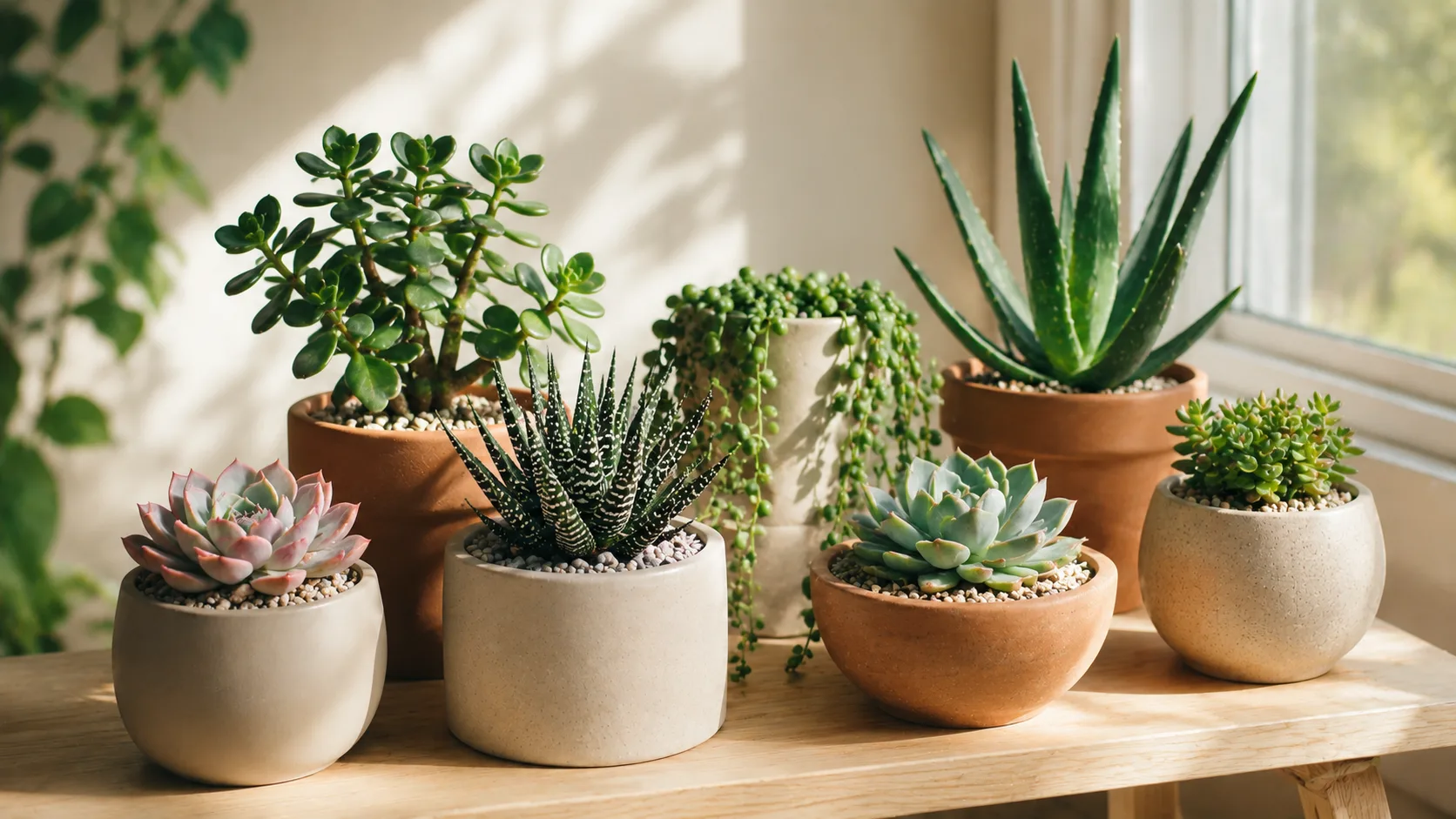
1. Echeveria
The classic rosette of decor magazines. Colours range from glaucous green to pastel pink, and even violet under light stress. Wants a south- or west-facing window with no sheer. Water every 15-25 days in summer, monthly in winter.
2. Haworthia
Small dark-green rosettes with white stripes. Distinctive: tolerates partial shade, making it the most forgiving succulent indoors. Perfect for an office with indirect light.
3. Sedum (stonecrop)
Huge variety — from ground-cover spreaders to trailing types. Sedum morganianum (burro’s tail) is particularly striking as a hanging plant. Wants lots of light.
4. Crassula ovata (jade plant)
The “bonsai” of succulents. Slow grower but can reach 1 m in 10 years. Very long-lived (30-50 years). Ideal for anyone wanting a long-term plant relationship.
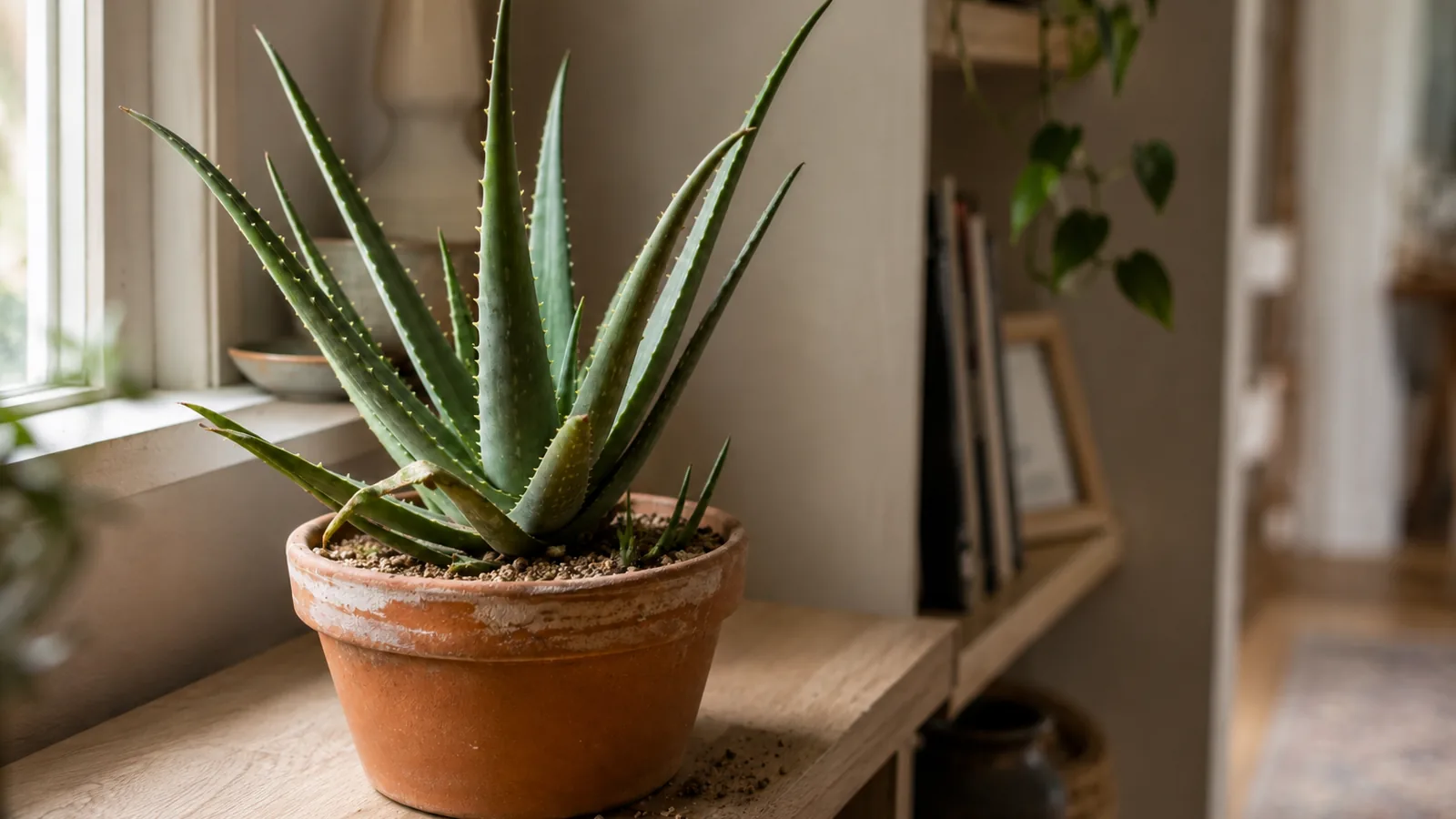
5. Aloe vera
The famous medicinal. Indoors, a south-facing window is essential. Very spaced-out watering. Bonus: the leaf gel soothes minor burns.
6. Kalanchoe
Best known for its spectacular winter blooming (red, pink, yellow). It’s a flowering succulent — give it bright light and very little water.
7. Sansevieria (Dracaena trifasciata)
Technically a succulent (even though we rarely think of it that way). It stores water in its thick leaves. Quirk: it’s the only succulent that tolerates deep partial shade. See our dedicated sansevieria guide on this.
8. Gasteria
Cousin to Haworthias. Thick speckled leaves, tolerant of moderate light. Slow grower, ideal for small spaces.
9. Lithops (living stones)
A fascinating botanical curiosity: they look like pebbles. Very demanding on light and watering (almost none in winter), but visually peerless. For seasoned collectors.
10. Senecio rowleyanus (string of pearls)
Trailing stems strung with green pearls. Stunning as a hanging plant. Wants plenty of bright light and very precise watering — it hates extreme drought as much as excess.
A bonus to flag: Peperomia ferreyrae (happy bean), technically a semi-succulent. Even more forgiving than true succulents, perfect to really get started.
Light: your first priority
If you take one thing from this guide, take this: before buying a succulent, measure the light where you’ll put it. Not after. Before.
The bare minimum
For 95% of succulents:
- Minimum: 3-4 hours of direct sun a day, or light equivalent to a south-facing window with no sheer, 50 cm away.
- Ideal: 5-6 hours of direct sun, like a south- or west-facing windowsill in full summer.
- Not enough: a bright room more than 1 m from a window. The plant will stretch within 2-4 months.
To really lock these notions in, read our complete light guide.
Signs of low light
- Stretching (etiolation): the stem lengthens abnormally between leaves, the rosette “climbs”.
- Faded colours: an Echeveria that should be pink turns greyish-green.
- Leaves angled towards the window: the plant leans hard towards the light source.
- Growth halted for 6+ months: outside of deep winter, that’s abnormal.
A stretched succulent will never return to its original shape. The only fix is to behead it (cut off the healthy top rosette, replant it) and give the new plant a properly lit spot.
When light is chronically insufficient
If your home is genuinely dark (ground floor, north exposure, few windows), consider:
- A horticultural LED lamp of 20-30 W, 30 cm above the plant, running 10-12 h/day. Effective and unobtrusive.
- Seasonal relocation: succulent on a balcony or sill from April to October, back inside near the best window for winter.
The soak method: the foolproof watering
Forget the weekly glass of water. The technique that works is the infrequent soak.
The protocol
- Wait until the substrate is completely dry top to bottom (check with a small stick that comes out clean).
- Then wait 3 to 5 more days — the plant isn’t suffering, it’s getting stronger.
- Soak the pot in 2-3 cm of water for 10-15 minutes (the water rises by capillarity).
- Lift out, let drain thoroughly for 20 minutes.
- Put it back. Don’t water again before the next cycle, even if you see the leaves wrinkling slightly — that’s normal.
Rough frequencies
- Summer (April-September): once every 15-25 days depending on heat and light.
- Winter (October-March): once a month max, or even every 6 weeks. The plant is resting.
These are rough numbers. The real test stays the dry-substrate check. Our general watering guide details the touch and weight tests.
Soft leaves vs wrinkled leaves: the critical distinction
This is the essential diagnosis for reading your succulent:
- Wrinkled, thin leaves: the plant is thirsty. Water within 24-48 h.
- Soft, translucent leaves that fall off at a touch: the plant is rotting, you’ve overwatered. Stop immediately, take it out of the pot, inspect the roots (black and mushy = rot, cut them off).
This distinction saves hundreds of plants every year. Many people water a mushy succulent thinking it’s thirsty — and accelerate the rot.
Substrate and pot: 90% mineral, drainage mandatory
Succulents sold at garden centres are nearly always potted in standard compost that holds too much water. First thing to do after buying: repot in a draining mix.
A solid succulent substrate recipe
A classic working blend:
- 40% houseplant compost (minimal water retention)
- 30% fine pumice or volcanic gravel (drainage, aeration)
- 20% perlite (lightens, drains)
- 10% coarse horticultural sand (never beach sand: too salty)
You can also try a 100% mineral substrate like pon (pumice + lava + zeolite). It’s what serious collectors recommend. To go further, see our pon substrate guide.
The pot: drainage non-negotiable
Never use a pot without a drainage hole for a succulent. A “decorative no-hole pot” is a marketing trap — guaranteed rot in 2-6 months.
Favour:
- Unglazed terracotta: porous, lets the substrate breathe. The best choice for beginners.
- A plastic pot with multiple drain holes, slipped into a decorative cover pot (which you empty after watering).
Pot size: just 1-2 cm wider than the root ball on the sides. Succulents hate oversized pots where moisture lingers under the roots.
Seasonal exposure and repotting
In spring
That’s the best time to repot. Growth resumes, the roots develop fast and colonise the new substrate. Do it every 2-3 years for slow growers, every 1-2 years for vigorous species (echeveria, crassula).
In summer
If you have a balcony or sunny sill, take your succulents outside. It’s their paradise. Acclimatise gradually (first few days in partial shade to avoid sunburn) then leave them in full sun. Bring them in before the first cool nights (below 8-10 °C overnight).
In winter
Cut watering drastically. An indoor succulent resting in mild heat can go 6-8 weeks without water. Place them by the brightest window possible, without leaves touching a cold pane.
The mistakes that kill succulents (don’t repeat them)
To recap, the 8 deadliest mistakes:
- Watering a little, often — the opposite: a lot, spaced out.
- Keeping the surface damp — let it dry all the way down + 3-5 more days.
- Pot with no drainage hole — guaranteed rot.
- Standard compost — far too water-retentive, repot into a mineral mix.
- A “bright” corner — 90% of the time, not enough light.
- Watering when leaves are mushy — often rot, not thirst.
- Misting the leaves — pointless and encourages spotting.
- Keeping a stretched plant as-is — behead it and root the healthy rosette.
If pests show up despite everything, see our dedicated guides on mealybugs and fungus gnats.
Conclusion
Succulents are not “the easy plant to give to someone with no green thumb”. Quite the opposite: they demand a precise understanding of their needs. Good news: once those needs are clear — plenty of light, very spaced-out watering, draining substrate, pot with drainage — they become the most tolerant plants you own. A well-settled echeveria can survive a 3-week holiday without flinching, and a well-cared-for crassula can live 50 years by your side.
If you’re truly starting out, run a easy classic potted plant alongside, to learn to observe a plant and read its signals. Once you can interpret a soft leaf, stalled growth or a shifting colour, your succulents will pay you back tenfold.
Frequently asked questions
- In 9 cases out of 10, it's overwatering causing root rot. A mushy, translucent leaf that falls off at a touch = rot, not thirst. Stop watering, unpot and inspect the roots. Cut off the black parts, let dry for 48 h, repot into a very well-draining substrate.
- Not on a schedule. Wait until the substrate is completely dry all the way down, then add 3-5 days of waiting. In practice: 15-25 days in summer, 30-45 days in winter. Soak for 10-15 minutes, then drain thoroughly.
- That's etiolation caused by low light. The plant won't go back to its original shape. Fix: behead the healthy top rosette with a clean knife, let dry 3-5 days, plant it in a draining substrate and place it in very bright light (south-facing window).
- Haworthia is probably the most tolerant, as it accepts partial shade. Otherwise Crassula ovata (jade plant) and Sedum are robust and forgive small mistakes. Skip Lithops, Senecio rowleyanus and most cacti at first — they're more demanding.
- Yes, it's even strongly recommended. Acclimatise them gradually the first 3-4 days in partial shade to avoid sunburn, then leave them in full sun. Bring them in before nights drop below 8-10 °C, except for hardy species (some Sedum, Sempervivum).