Indoor Living Wall: How to Build a Vertical Garden at Home
Types of living walls, suitable plants, watering, light, budget and care. The complete guide to creating a vertical garden indoors.
By SPRAIA editorial team · Method: botanical sources, field feedback and editorial validation
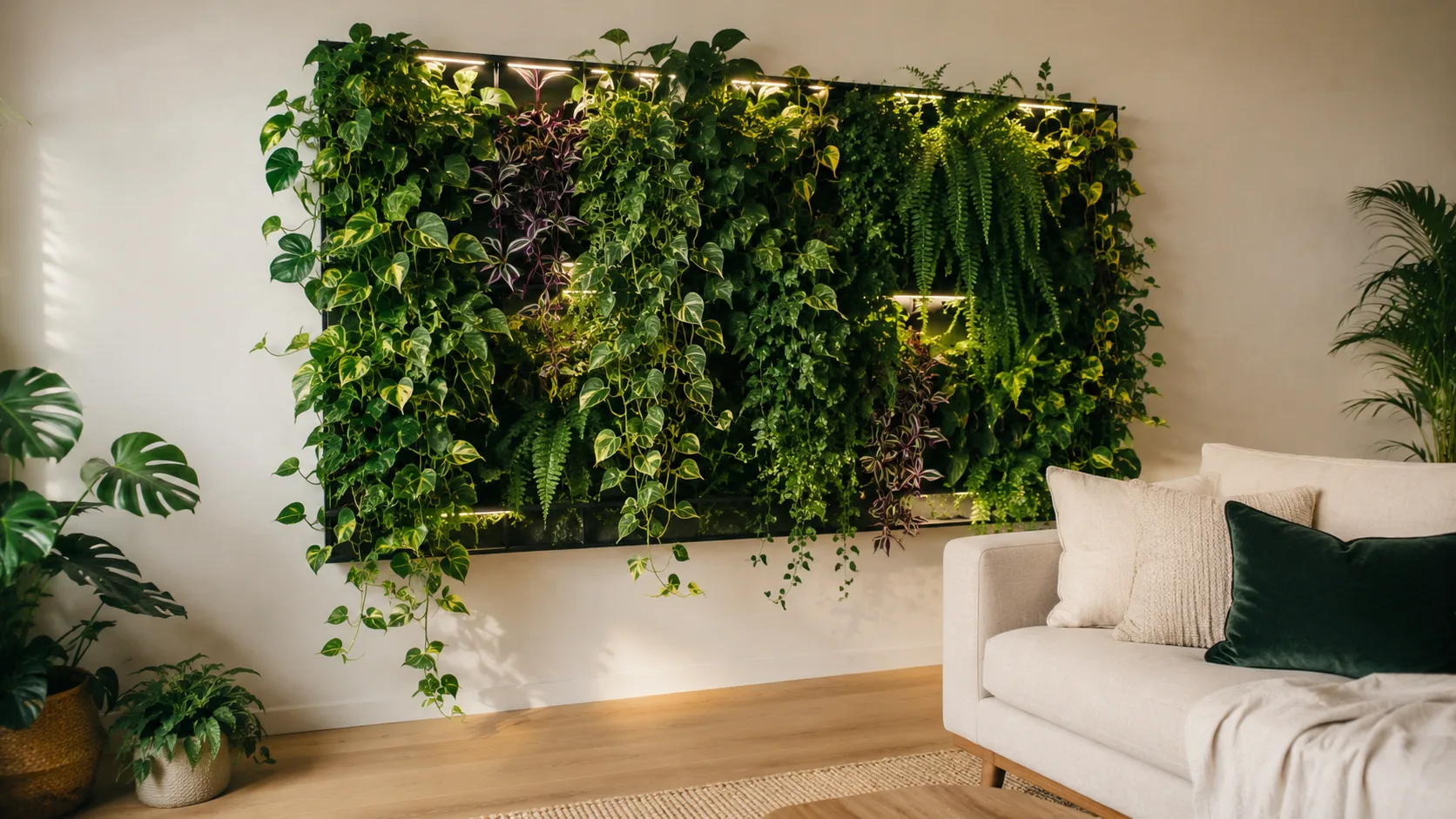
You’ve seen those Pinterest shots: a full wall covered in foliage, like a suspended forest inside a living room. You said to yourself, “I want one” — and then you started researching, and the questions piled up. Which system? Which plants? How much does it cost? And above all: how do you avoid ending up, six months later, with nothing but a row of dried stems? The truth is that a successful indoor living wall stands on three technical pillars — light, water, plant choice — far more than on the design itself. This guide walks you through the full how-to, with realistic budgets and the pitfalls to dodge.
The different types of living walls
Before picking a system, ask yourself a simple question: are you willing to look after a living wall every week, or do you want something nearly self-running? The answer drives everything.
1. The hydroponic wall (soil-free)
The professional top-tier. Plants sit in a horticultural felt watered in a closed loop by a pump. No substrate, just a water-and-nutrient mix flowing continuously.
- Pros: very dense, flawless aesthetics, automated care.
- Cons: £700-2,200/m² installed, technical, requires solid light.
- Who for: ambitious project, main room, serious budget.
2. The modular pot wall
Plastic trays or pockets clip onto a wall structure. Each module holds a potted plant with its own substrate.
- Pros: £180-450/m², more flexible, plants are interchangeable.
- Cons: individual or semi-automated watering, visible joints between modules.
- Who for: the most versatile home option.
3. The plant frame
A living artwork in a frame, like a painting, with an internal water reservoir. Limited format (30 × 50 cm to 1 × 2 m).
- Pros: £70-350, compact, low maintenance.
- Cons: few plants, limited species choice (often succulents or preserved plants).
- Who for: entryway, office, room with no nearby plumbing.
4. DIY pallet or trellis
A reclaimed wood pallet, a metal trellis, or hanging crates. You place classic pots inside and let the foliage trail down.
- Pros: £45-130 depending on salvage, creative, modular.
- Cons: less “pro” look, waterproofing must be managed (the wall behind needs protecting).
- Who for: starting a collection, renting, low-budget personal project.
5. The preserved plant wall
Not a true living wall, but a freeze-dried decoration. Preserved mosses and foliage need zero maintenance, but they’re no longer alive.
- Pros: £90-270/m², zero care, zero light needed.
- Cons: it’s no longer a plant; visual quality degrades after 5-7 years.
- Who for: dark hallways, spaces with no natural light.
Challenge number one: light
If one factor sinks 80% of living walls installed in homes, it’s lack of light. An indoor wall, by definition, is set against a partition — so far from the window. Leaves moving away from the light source switch to survival mode.
How much light do you need?
For a thriving, dense living wall, count on a minimum of 800-1,500 lux at the last row of plants (the one furthest from the window), 10-12 hours a day. For comparison, a “bright” living-room corner 3 m from a window rarely exceeds 200-400 lux. To get a real feel for what those numbers mean, read our complete light guide.
The fix: horticultural LED lighting
Unless your wall sits right next to a large south-facing window, you’ll need supplemental lighting. Look for:
- Full-spectrum horticultural LEDs (3,000-6,500 K).
- A power of 20-40 W per m² of wall.
- A timer running 10-14 h/day.
- A distance of 30-80 cm between the lamp and the plants.
Plan £90-220 for a decent home LED kit. It’s an often-forgotten budget line, but it’s what makes the difference between a wall that thrives and one that fades.
Which plants to choose?
Not just anything. A vertical living wall imposes specific constraints: limited substrate, water run-off, cramped roots, very close neighbours. The best candidates are epiphytes, trailers or creepers that tolerate medium light.
Top 8 plants for an indoor living wall
- Pothos (Epipremnum aureum): the undisputed star. Fast grower, tolerates partial shade, cascades beautifully. See our complete Pothos guide.
- Heartleaf philodendron (Philodendron scandens): cordate leaves, trailing, ultra-resilient. Also see our Philodendron species guide.
- Boston fern (Nephrolepis): loves the constant humidity of a watered wall.
- Bird’s nest fern (Asplenium nidus): architectural foliage, copes with partial shade.
- Tradescantia zebrina: purple shades, fast-growing, trailing.
- Spider plant (Chlorophytum): very tolerant, sends out plantlets.
- Peperomia rotundifolia: small round leaves, ideal in the foreground.
- Fittonia: pink or white veins, perfect for filling gaps.
What to avoid
- Succulents and cacti: they need direct sun and hate the humidity of a dripping wall.
- Calatheas: too demanding on stable ambient humidity.
- Flowering plants: fleeting blooms, poor effort-to-effect ratio.
- Slow growers like sansevieria: they’ll never fill the wall.
Stick to just 3 to 5 species for a visually coherent wall. Too many species creates a busy, unpleasant “jumble” effect.
The watering system: the key to autonomy
This is where you need to be honest. Watering a living wall by hand, plant by plant, takes 30-45 minutes a week. For 1-2 m², it’s manageable. Beyond that, you’ll give up within six months. Here are the options.
Option 1: hand watering
Works for small walls (< 1 m²) and plant frames. Use a long-spout watering can or a spray bottle. Check each pot individually. Read our right-way-to-water method — it applies perfectly plant by plant.
Option 2: gravity-fed drip
A reservoir at the top of the wall delivers water drop by drop via micro-tubing to each plant. No pump. Around £70-180 in kit form. Manual reservoir refill every 2-4 weeks.
Option 3: motorised closed loop
A submersible pump draws from a reservoir at the bottom of the wall, lifts the water, which trickles through the plants and falls back into the tank. For hydroponic walls. Around £270-700 in kit form, with a timer. Reservoir refill every 1-2 months.
The common trap: water running down the wall
Any watering system must come with a collection gutter at the base of the wall, a waterproof film behind the structure, and a minimum 2-3 cm gap between the structure and the load-bearing wall. Without that, you’ll condemn the partition to chronic damp, mould and water damage. If you start seeing fungus gnats in the substrate, that’s often the signal of excess moisture — act fast.
Substrate and drainage: a delicate balance
On a wall, the constraints are flipped compared to a classic pot: water tends to run off too fast or to pool depending on the system. The right substrate makes all the difference.
For a modular wall or a frame, favour a blend of:
- 50% quality houseplant compost
- 25% perlite (lightens, drains)
- 15% fine pine bark (aerates, gives structure)
- 10% vermiculite or fine pumice (holds just the right amount of moisture)
For a hydroponic wall, no soil at all: it’s felt + liquid nutrients in a closed loop. If you want to go further on mineral substrates that work well vertically, read our complete pon substrate guide.
Drainage is crucial: plan drain holes at the bottom of every module and a collection tray. A plant sitting in stagnant water rots in less than three weeks.
The weekly care routine: what actually matters
A living wall isn’t self-sufficient, even an automated hydroponic one. Here’s your realistic routine:
Every week (15-30 min)
- Visual sweep: remove yellow or damaged leaves.
- Check the reservoir level.
- Quick misting to boost humidity.
- Spot any plant “lagging” (yellowing, growth stalled).
Every month (1 h)
- Light trimming of trailing plants (pothos, philodendron) to stay dense.
- Test the reservoir water pH (ideal 6.0-6.5).
- Apply diluted liquid fertiliser.
- Wipe leaves with a damp microfibre cloth.
Every 6-12 months
- Replace plants that didn’t make it.
- Deep-clean the pump and tubing.
- Rework a zone if certain plants have taken over.
A beginner launching into a living wall should ideally cut their teeth on easy potted plants for 6-12 months first — you’ll understand your plants’ needs much better once you’ve lived with them daily.
Realistic budget for 1 m² of living wall
To set your expectations, here are three typical budgets for 1 m² of wall installed at home:
DIY budget (£270-540)
- Reclaimed-wood structure or repurposed IKEA frame: £45-90
- 10-15 small plants (6-10 cm pots): £70-130
- Substrate, clay pellets, perlite: £25-45
- Basic LED lighting: £55-110
- Hand watering or gravity drip: £25-90
Mid-range budget (£720-1,350)
- Ready-to-mount modular system: £180-360
- 20-30 well-sized plants: £180-320
- Full-spectrum LED lighting: £130-220
- Gravity or pumped drip: £90-220
- Waterproofing, gutter, accessories: £90-180
Pro budget (£2,200-4,500+)
- Professional hydroponic wall: £1,350-2,700
- Pre-installed plants: included or £360-720
- High-efficiency LED lighting: £270-540
- Installation + plumbing: £450-900
Double or triple these figures for 2-3 m². And don’t forget the annual plant-replacement cost: roughly 15-25% of the original plant count per year.
Classic mistakes to avoid
- Installing a wall in a room with no natural light without planning horticultural lighting.
- Picking succulents to look “on trend” — they can’t take running water.
- Skipping waterproofing: your partition will be ruined in 1-2 years.
- Going too big: 4 m² is very ambitious for a first project.
- Mixing too many species: 3-5 max for a coherent visual.
- Assuming “it’s hands-off”: no living wall truly is — budget at least 1 h/week.
Conclusion
An indoor living wall is a thrilling but demanding project. Make the smart bet of starting small: a 50 × 70 cm plant frame, or a 1 m² modular wall in the brightest room, with 3-5 easy species and an LED rig. Learn to keep it alive, then expand. The spectacular walls that last are the ones that grew gradually, plant by plant, rather than the ones installed in a single day by a contractor.
With a bit of patience and the right habits, your wall will become a living focal point in your home — a miniature ecosystem that shifts with the seasons and transforms both the air quality and your mood.
Frequently asked questions
- For a first project, aim for 1 to 2 m² maximum. That's enough for strong visual impact, and small enough to manage watering, lighting and waterproofing without burning out. You can expand later once the first build is dialled in.
- Unless the wall sits less than a metre from a large south- or east-facing window, yes. Most indoor walls get less than 300 lux — well below the 800-1,500 lux needed. A 20-40 W/m² horticultural LED kit makes all the difference.
- Count on 15 to 45 minutes per week for 1-2 m² depending on the watering system. An automated hydroponic wall mainly needs visual checks. A hand-watered DIY wall takes more time. No wall is fully self-sufficient.
- Pothos, heartleaf philodendron, spider plant, Tradescantia zebrina and Boston fern are the safe bets. They tolerate partial shade, grow fast, and trail or spread naturally. Avoid succulents and Calatheas on a wall.
- DIY: count on £540-1,100 (structure, plants, lighting, watering). In a modular kit: £1,350-2,700. In a professional hydroponic install: £3,600-7,000 fitted. Add 15-25% per year for replacement of plants that didn't survive.